
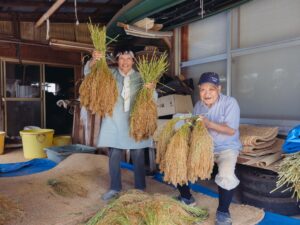
Sumiko Hinoura | The People Supporting Globally Important Agricultural Heritage System
Sumiko Hinoura (Farmer in Tsurugi Town ) Sumiko Hinoura grows vegetables and millets in a mountain field that overlooks the Yoshino River. She grows many vegetables throughout the year, such as cucumbers, tomatoes, and beans. Every year, she grows buckwheat and amaranth; however, this year, she has started growing common millet. The millet grew well and weighed approximately 40 kg. Threshing was performed with the help of Tsurugi Millet Production Association members. The harvested common millets were wrapped overnight in a mushiro (straw mat) to facilitate threshing. The common millet was removed by stepping on it with one foot. Common millet has a beautiful aroma and chewy texture when cooked […]
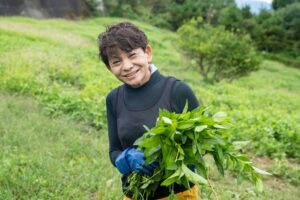
Kyoko Tochitani|The People Supporting Globally Important Agricultural Heritage System
Kyoko Tochitani (Tsurugi Town / Keka Renovation Project) Mrs. Kyoko Tochitani represents the Keka Renovation Project and is the initiator of Indigo cultivation. She wanted to produce "Edible Indigo" in the Keka district of Tsurugi town, where Indigo cultivation used to be actively carried out. Keka's Indigo is cultivated using traditional farming methods. The fields of Tadeai are covered with kaya straw and fallen leaves. No chemical fertilizers or pesticides are used. "Keka's Aifun (Edible Indigo Powder)" is made from dried and powdered indigo leaves grown with great care. Mrs. Tochitani produces and sells this product, which is good for our bodies because she wants consumers to eat Indigo without […]
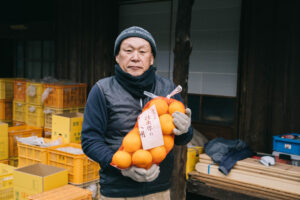
Shinichi Maeda|The People Supporting Globally Important Agricultural Heritage System
Shinichi Maeda (Mima City / Hassaku Orange Farm) Shidehara, in Mima City, is located along the Anabuki River, one of the clearest streams in Shikoku, and is known as a production area of the Hassaku orange. The eight farmers of the "Shidehara Hassaku Orange Production Association," which is certified as Eco-Farmer, ship approximately 50 tons of Hassaku orange annually. The Hassaku orange is grown by skilled farmers using reduced pesticides and organic fertilizers and has been exported to Europe for six years. Mr. Shinichi Maeda is the head of the Shidehara Hassaku Orange Production Association. Sericulture used to flourish in this area. Mr. Maeda's father started growing Hassaku orange in […]
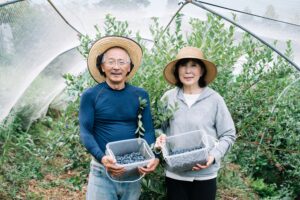
Yoshinobu Fujio and Kinuyo Fujio|The People Supporting Globally Important Agricultural Heritage System
Yoshinobu Fujio and Kinuyo Fujio (Wakimachi in Mima City) A field with 600 blueberry trees is in a mountainous area at 400 meters. Mr. Yoshinobu Fujio and his wife, Mrs. Kinuyo, run a blueberry farm in Nishi-Otani, Wakimachi, Mima city.Mr. Yoshinobu took early retirement from his company when he was 51 years old and started farming in 2006. He started growing blueberries to use them as an ingredient for his wife’s bread making.In the first year, they planted about 80 blueberry trees. Each year, they added more trees, and now they grow 600 blueberry trees of 60 different varieties without any pesticides. The dark-purple-colored blueberries are harvested annually from the […]
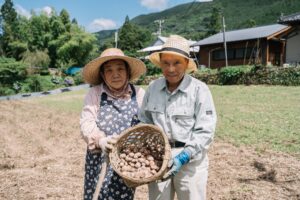
Fumihiro Okamoto and Reiko Okamoto|The People Supporting Globally Important Agricultural Heritage System
Okamoto and Reiko Okamoto (Higashi-Iya in Miyoshi City / Farmer) Mr. and Mrs. Okamoto grow "Goushu potato" in Higashi-iya, Miyoshi city. This type of potato has been cultivated since ancient times in the mountainous area around Mt. Tsurugi. It is said to have originated from the Heike clan, who were driven out of the capital and fell into the East-iya region in the old days. It is grown on well-drained sloping lands. Layers of Kaya on the fields effectively prevent frost and suppress weeds to grow vegetables. Potatoes are harvested from July to August. They are small and found in white and red colors. Most of them were home-consumed, but […]
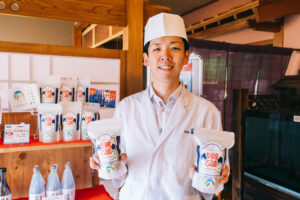
Shinya Fujimoto|The People Supporting Globally Important Agricultural Heritage System
Shinya Fujimoto (Japanese Cuisine Ajisho Fujimoto) (Higashi-Miyoshi town) Mr. Shinya Fujimoto is the head chef of Japanese Cuisine Ajisho Fujimoto in Higashi-Miyoshi town. He developed “A specialty of Nishi-Awa Awa-Okoshi” to promote the attractiveness of buckwheat rice, a local ingredient. This specialty is made from puffed buckwheat rice covered with brown sugar, syrup, or honey. You can enjoy the crunchy texture of the Okoshi. Chef Fujimoto gained experience at a traditional Japanese restaurant in Osaka and a hotel in Kyoto. The product, which takes full advantage of the taste and aroma of the ingredients, has been popularized as a “new way to eat buckwheat rice.” It is handmade one by […]
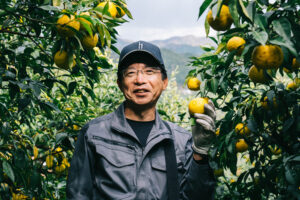
Hiroshi Nakamura|The People Supporting Globally Important Agricultural Heritage System
Hiroshi Nakamura(Nakamura Farm) (Yamashiro Town in Miyoshi City) A special space that almost seems to reach for the clouds and the sky; this is why Mr. Nakamura's Yuzu is called "Tokushima Yuzu in the Sky". Yuzu grows in an unobstructed environment with sufficient sunlight. The significant temperature difference between day and night and the well-drained sloping lands produce highly fragrant and juicy Yuzu. Mr. Nakamura uses herbaceous cultivation to plant "Festuca myuros" for undergrowth instead of using herbicides or chemical fertilizers. When the Kaya dies, it naturally falls over and covers the ground to prevent the growth of weeds; this undergrowth becomes green manure and makes the soil rich. Ladybugs […]
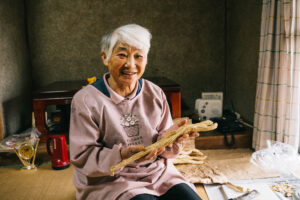
Fumi Ichihara|The People Supporting Globally Important Agricultural Heritage System
Fumi Ichihara (Tsurugi Town) Radishes are dried and processed as preserved food during the cold winter season in the mountainous areas of Nishi-Awa. Mrs. Fumi Ichihara, who lives in Nagase, Tsurugi, peels radishes grown on a slope and hangs them under the eaves to dry for approximately one month every December. They are exposed to cool breezes that keep them out of the rain under the eaves to dry and increase their sweetness. She uses a knife to thinly chop the dried radish to approximately one-tenth of the original thickness. The radish was cut into round slices approximately 2 mm in diameter and dried again to complete the drying process. […]