
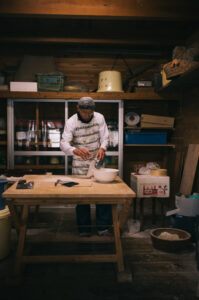
Hajime Onishi | The People Supporting Globally Important Agricultural Heritage System
Hajime Onishi(Miyoshi City) The Shitsukawa District is a quiet village surrounded by mountains. Hajime Onishi, a well-known master of traditional soba noodle making, grows buckwheat here. Although a carpenter by trade, he developed a deep interest in making soba after learning the technique from a friend about 20 years ago. He cultivates buckwheat on a 4000 m2 field near his home and harvests approximately 200 kg of buckwheat annually, which he uses to make soba noodles. What began as a hobby, soon gained a strong reputation in the local community because of its exceptional taste. From 2023, he ran a soba restaurant for two years in the Kurozo Wetlands. His […]
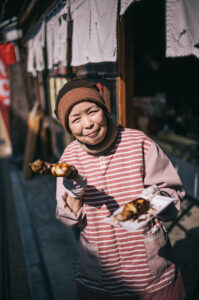
Sayoko Nakajima | The People Supporting Globally Important Agricultural Heritage System
Sayoko Nakajima(Mima City, Minshuku Nakajima) A popular farm stay in Yokokura, a mountainous area close to the border with Kagawa Prefecture, attracts overseas guests despite its distance from major roads and tourist attractions. Sayoko Nakajima opened her farm stay to guests in 2018. Her home is surrounded by vegetable fields such as tomatoes and green peppers, which are shipped to local farmers’ markets. Students from urban areas on school trips also visit to enjoy hands-on harvesting experiences. Thanks to its location, approximately 40 minutes from Takamatsu Airport, Yokokura has seen a growing number of international visitors. The farm stay has become popular through word of mouth as a place where […]
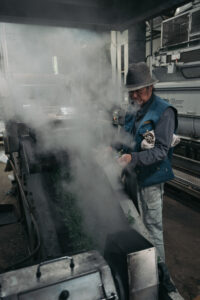
Kazuo Matsuoka | The People Supporting Globally Important Agricultural Heritage System
Kazuo Matsuoka(Tsurugi town) The Ono hamlet in Ichiu, Tsurugi, can be found upstream of the Sadamitsu River. Situated on mountain slopes at elevations of 500–600 m, the area is dotted with numerous tea fields. Kazuo Matsuoka grows tea here and says that adding organic fertilizers such as cut grass and cow manure to the fields in autumn enhances the tea’s aroma. Ono hamlet has a tea-processing facility operated by local residents that allows freshly harvested tea leaves to be processed immediately. This is another key factor in the production of high-quality teas. Tea with a darker color after processing is a sign that the fertilizer has worked well, resulting in […]
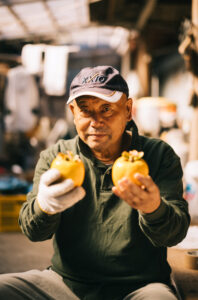
Seiji Miyoshi | The People Supporting Globally Important Agricultural Heritage System
Seiji Miyoshi(Tsurugi town, Sansei, LLC) The Hiraraishi district in Tsurugi overlooks the Handa Basin and is known for its persimmon cultivation, which takes advantage of well-drained mountain slopes. In autumn, the mountains turn bright orange with Atago persimmons. Seiji Miyoshi grows Atago persimmons that have been passed down from his mother. During the harvest season in early November, people from outside the town come to help, drawn by his warm and welcoming personality. The harvested persimmons are packed the following day and shipped to the markets in Osaka and Tokyo. Miyoshi also ages Atago persimmons using his own method and sells them as persimmon vinegar and juice. Persimmons are rich […]
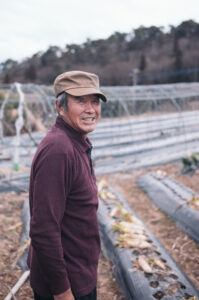
Masakazu Kubota | The People Supporting Globally Important Agricultural Heritage System
Masakazu Kubota(Mima) The Nodanoi district is approximately a 10-minute drive into the mountains from the Mima Interchange. This small mountain hamlet sits at an elevation of approximately 600 m near the border with the Kagawa Prefecture. Until the 1950s, this area practiced a tradition known as Kariko-ushi in which cattle were lent to farmers across the mountains in Kagawa for agricultural work. Masakazu Kubota is a ninth-generation farmer whose family has been farming for over 200 years. Leaf tobacco was once grown in sunny south-facing fields. Currently, multiple vegetables, including tomatoes, snow peas, and sweet potatoes, are cultivated throughout the year. In spring and autumn, he welcomes students from urban […]
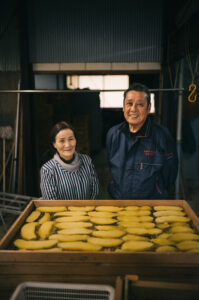
Hitoshi and Kumiko Kajiura | The People Supporting Globally Important Agricultural Heritage System
Hitoshi and Kumiko Kajiura (Mima City) The Nodanoi area of Mima Town in Mima City is a small mountain hamlet located near Mt. Santo and is known as a hang-gliding launch site. Here, the Kajiuras grow chili peppers that are used as the main ingredient in Mimakara, a specialty of Nishi-Awa, which is widely sold at roadside stations and farmers’ markets. In the Kajiuras’ chili fields, neatly cut kaya grass is spread across the ground like a carpet. This traditional practice enriches the soil, prevents erosion caused by rain, retains moisture, and suppresses weed growth. Indigenous chili peppers in this area are harvested from mid-July to October. Green chilies are […]
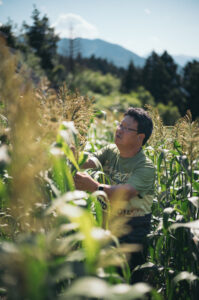
Isogai Kazuyuki | The People Supporting Globally Important Agricultural Heritage System
Isogai Kazuyuki(Tsurugi town, Isogai Farm, Sora no Yado Isogai) Isogai Farm, located in the Michidoki district of Sadamitsu, Tsurugi, practices traditional farming on steep slopes and cultivates indigenous millets such as buckwheat and finger millets, along with multiple seasonal vegetables. The farm also offers farm stay accommodations, where hands-on experiences such as making konnyaku and Dango (mochi balls) are especially popular with visitors. Kazuyuki Isogai began working in agriculture at his family’s farm in 2020. Before that, he was employed at a company in the Tokushima Prefecture. His parents long managed the farm, but as they aged, he decided to take over the family business. “Before I started, I was […]

Kayo Iba | The People Supporting Globally Important Agricultural Heritage System
Kayo Iba(Tsurugi town) Kayo Iba, a resident of Tsurugi, is an active influencer and shares the ancient legend of Tokushima. In September 2024, she published a book on the legends associated with the Kojiki and Mt. Tsurugi. In addition to her cultural work, she is a registered dietitian skilled in cooking and baking. She runs a café at an accommodation facility in Mima City where she serves coffee and chiffon cakes. Inspired by a desire to create products using local specialties, she developed a bagel made of indigenous millets cultivated on the steep slopes of Tsurugi, called the “Mt. Tsurugi Bagel.” This bagel is made with satisfyingly chewy dough fermented […]
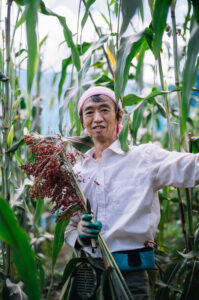
Yasunori Nakajima | The People Supporting Globally Important Agricultural Heritage System
Yasunori Nakajima(Tsurugi town, cultivating Takakibi (sorghum)) A blue net stretches across a steep mountainside, serving as a protective barrier against Takakibi (sorghum) nuts from birds. In 2015, Yasunori Nakajima relocated from the Kanagawa Prefecture to Tsurugi town, where his grandmother lives, to practice farming. His farm is located at an altitude of approximately 600 m above sea level. The mountain slopes are well-drained, and significant temperature difference facilitates vegetable and millet cultivation. Every year, he grows Takakibi (sorghum) in his field. Takakibi seeds are sown in late April with the seedlings developing for approximately a month. Once the seedlings attain a height of 15–20 cm, they are transplanted to the […]
Minori-no-Mori Indigo producer’s association | The People Supporting Globally Important Agricultural Heritage System
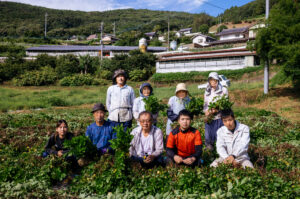
Minori-no-Mori Indigo producer’s association(Mima city, indigo cultivation) Kirikubo village is located in Mima town, Mima city. In summer, fields on the slopes are covered with bright green leaves. These fields are planted with Tade-ai, whose leaves are used for indigo dyeing. Notably, the indigo cultivated here also serves as a food source. The Awa domain has promoted indigo cultivation in the Yoshino River basin since the Azuchi-Momoyama period. From the mid-Edo period until the late Meiji period, indigo cultivation flourished due to increased demand. However, indigo cultivation declined following the importation of cheaper indigo from India. In recent years, scientific research revealed that indigo contains antioxidants (indigo polyphenols and flavonoids) […]
Akira Kondo | The People Supporting Globally Important Agricultural Heritage System
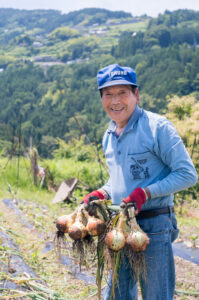
Akira Kondo(Higashi-Miyoshi Town, Ichigo House Farm Inn) Higashi-Miyoshi is a rare region of Japan where strawberries can be harvested year-round in greenhouses in the mountains and plains. In addition to strawberries, Akira Kondo grows onions in the mountain fields where his home is located. He stated that a well-drained field on a slope produces good-quality onions. In the fields, kaya is used as a fertilizer. Additionally, in the plain area of Miyoshi City, he owns a greenhouse for growing strawberries, where he also offers the strawberry-picking experience to customers. His son, Masashi, serves konjac made from homemade Konjac bulbs to customers. Thinly sliced Konjac is relished with yuzu ponzu (citrus […]
Kikue Nagae | The People Supporting Globally Important Agricultural Heritage System
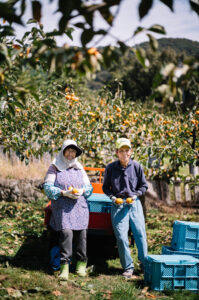
Kikue Nagae(Farmer in Mima city) Mrs. Nagae cultivates persimmons on the slopes of the Asan Mountains, situated on the northern bank of the Yoshino River. Previously, she cultivated Hassaku oranges. However, after the trees perished during a particularly severe winter, she transitioned to persimmon cultivation in 1988. She cultivates seven varieties of persimmons, including Tonegaki, Hiratanegaki, and Yamatogaki. The harvest season is from mid-September to late November. The harvested persimmons are sold at local roadside stations or sent to suppliers outside the prefecture for processing into Japanese sweets and other products. Additionally, she sells seasonal vegetables at roadside stations. “Cultivation, pruning, and harvesting of persimmons is labor-intensive,” she said, “but […]